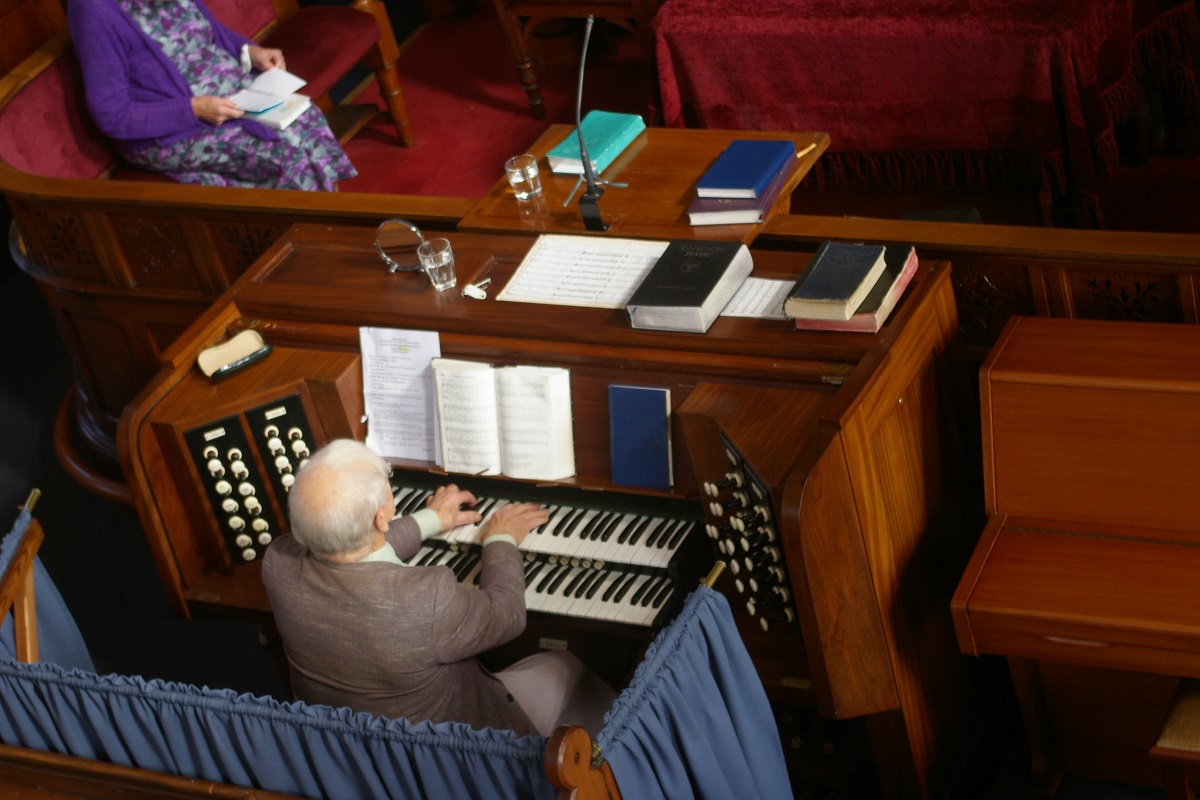
Our Organist, Ian Hunt
The chapel was built in 1897 as a "break off" from Capel Mawr on the High Street, which has been in existence since the early 1870's, the new chapel being Capel Seion (Capel Mawr still stands, next to the George Hotel, although it closed around 20 years ago, when the two congregations united again, now Capel y Traeth). (Similar unifications taking place in Porthmadog, Pwllheli and Caernarfon). For around 30 years, from when it was built in 1897 Seion (Capel y Traeth) did not have a pipe organ, only a reed organ (harmonium). When finance was available, around the late 1920's the pipe organ was installed, by organ builders, J.W.Walker. They were prolific builders of, what are known as extension pipe organs, of which there are (were!) a lot in this part of Wales. (They are an instrument that can be installed where space availability is limited, as they use a technique of making multiple use of fewer ranks of pipes, to produce the versatility and volume of a larger instrument). The organ case will be the original Walker, and I would guess, all (or most) of the original Walker pipe work remains in situ. As can be seen the pipe case is wide, (the width between the side galleries) but very narrow, between the back wall and the front pipes, only 1.5 metres (5 feet), so as mentioned above, within the limited available space, there are around 700 pipes in the organ, ranging in size from the size of a pencil, up to the large one ones visible. Because of the extension system used, the organ has the versatility and power of an organ with double that number of pipes. The console has always been in its present position, at the front of the chapel, below the pulpit with electric action to the organ itself. For the uninitiated, the action is the means by which the organist’s actions - playing the keys, changing the various controls, such as the stops - are transmitted from the console to the organ itself, within the case. The original console had tab stops, but another console was installed in 2011, which now has traditional draw stops - that are pulled/pushed in and out. It was in 2011 that much work was done on the organ, including the addition of some electronic bass, to boost the somewhat weak bass sound, due to the limited number of bass pipes that could be accommodated in the limited case size, pipe organ purists (such as myself) don't usually take kindly to electronic sound production, but, in this case, I have to admit that it has vastly improved the sound, and the volume, of the organ.
Ian Hunt. 2024
News etc will be published on our Facebook Page
If you have questions please contact Michael Sharratt on 01766 770099, if there is no reply you can leave a message
Last updated: 23rd May 2024